
AI Is Shifting the Automation Frontier
In The Automation Opportunity Matrix, we introduced a framework for evaluating what is worth automating: score processes against six dimensions, plot them on a two-axis grid, and focus on the quadrant with the highest return for the lowest difficulty.
That framework is useful. But it has an implicit assumption that needs challenging: that the difficulty axis is fixed.
It is not. And AI is the reason.
The Old Blocker: Messy Data
Historically, inconsistent data was a hard blocker for automation. If inputs were unpredictable - variable formats, inconsistent naming, unstructured text - automation was considered impractical. Organisations tried to solve this with brittle workarounds, and it rarely worked well.
Consider a concrete example from engineering.
Engineering drawing metadata is full of codes, abbreviations, and domain-specific terminology. A standard spell checker is useless in this context - it returns false positives on almost every entry because it does not understand that "DN150" is a pipe size, not a typo.
So organisations resorted to maintaining enormous lookup tables of "frequently misspelled words." Every known variation of common mistakes was catalogued manually: "simul" instead of "simple," "recieved" instead of "received," dozens of variations per word. These lists grew endlessly, never caught new mistakes, and were impossible to maintain. It was an extraordinary amount of effort for a solution that was always incomplete.
AI as a Preprocessing Layer
AI changes this equation entirely.
An AI classification or validation step can be injected before the deterministic automation runs. Instead of a brittle lookup table, you prompt an AI model: "This is engineering metadata. There will be acronyms and codes - ignore those. Flag any obvious natural-language spelling errors." The AI handles the messy, probabilistic front end. The deterministic automation handles the structured work that follows.
The same pattern applies to classification. If incoming data does not have a category tag, instead of failing or requiring manual classification, an AI step can classify it against a list of acceptable categories. It will not be right 100% of the time - but at 85-95% accuracy, it eliminates the vast majority of manual classification effort.
This is the deterministic and probabilistic working together - AI prepares, recommends, and preprocesses; deterministic systems execute, enforce, and audit.
What This Means for the Matrix
Go back to the Automation Opportunity Matrix. Processes that previously sat in the "high difficulty" row - because their inputs were too messy or too unpredictable - can now shift downward. AI does not eliminate the difficulty, but it compresses it. An opportunity that was "usually avoid" two years ago might now be a strong candidate.
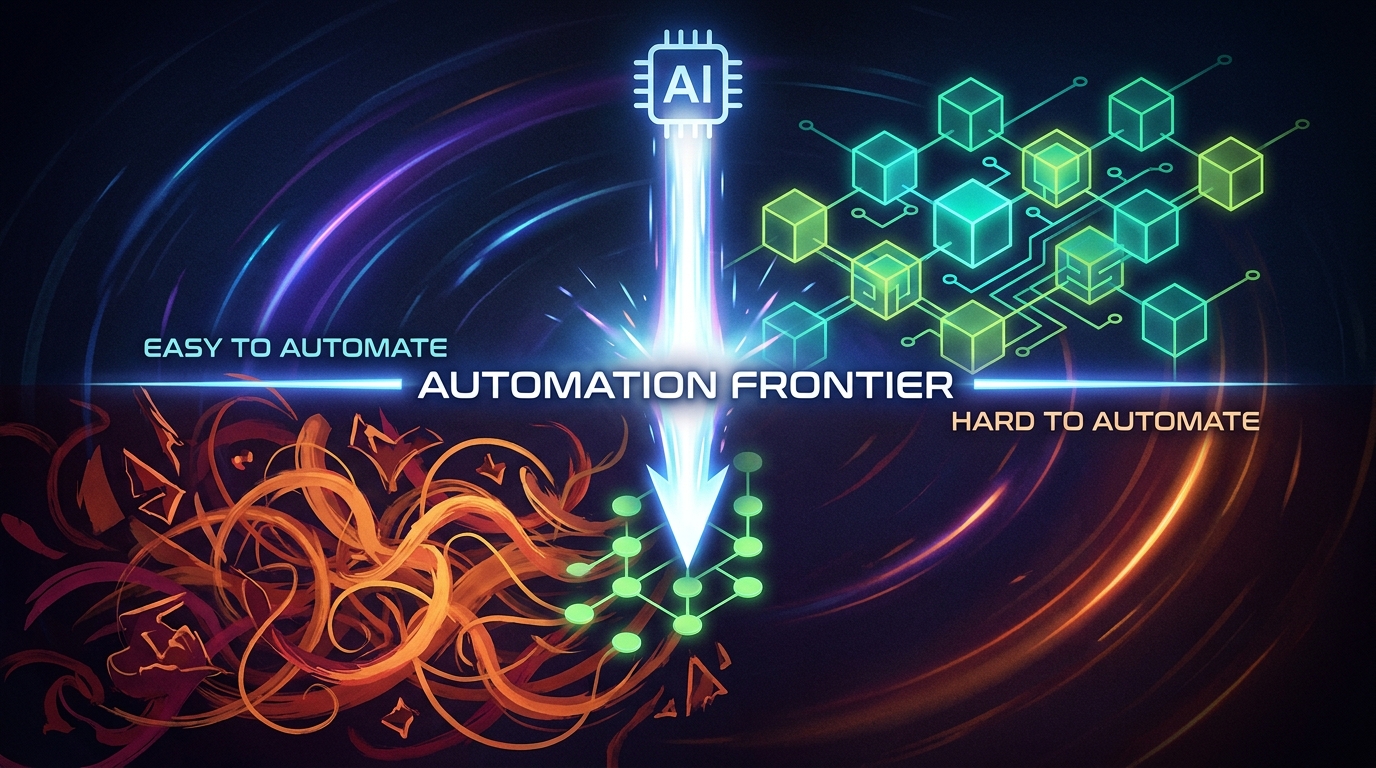
The matrix is not static. It should be reassessed periodically as the available tooling evolves. What was impractical last year may be straightforward today.
The Real Gate: Ownership, Not Data Quality
The traditional objection to automating messy processes was "the data isn't good enough." AI has largely neutralised that objection. But a new question takes its place - one that is harder to answer with technology.
When the AI and automation combination does not get it right - and it will not, every time - who owns the exceptions?
- Who triages the 5-15% that the AI could not classify confidently?
- Who reviews the flagged items?
- Who decides when the AI's accuracy has drifted and the model needs adjustment?
- Who receives the alert when the automation fails at 2am?
If nobody owns that, the automation degrades silently. It does not matter how good the AI layer is. It does not matter which quadrant the opportunity sits in. Without ownership, every automation is a liability.
The question is no longer "can we automate this?"
It is "will someone take ownership of it when it doesn't work?"
The Takeaway
AI is expanding the boundary of what can be automated. Processes that were once blocked by messy data or unpredictable inputs are now viable candidates - not because AI makes them perfect, but because AI handles enough of the variability that deterministic automation can take over.
But expanding what is possible does not change the fundamental requirement. For every opportunity - whether it was always a strong candidate or has only recently become one - there is one question that must be answered before any work begins:
Who will own this after go-live?
If you cannot name that person - if ownership is vague, shared across too many people, or assumed to be "IT" without anyone in IT agreeing - the opportunity is not ready. Regardless of where it sits on the grid.
Start with the matrix. Use AI to expand what is reachable. But finish with the question: who owns this?